Saturday, September 3, 2005

The World Awakens


Grade 5.1.1.3

As Europe learns more about the world, navigators seek new routes to the treasures of Asia. Columbus plans a voyage to the Orient.

 In this age of jet planes that soar across the ocean in a few hours, it is difficult to imagine how much smaller was the world of a thousand years ago. If you had lived in Europe then, the chances are that from birth to death you would never have trav­eled more than a dozen miles from your home. Everything you needed to exist would be produced in the town or manor of your birth—all the food you ate, the sim­ple clothes you wore, the crude tools you used. If by luck you had been born a lord, you would have spent your time hunting or jousting or carrying on small wars over boundaries and hunting rights with the owners of neighboring manors. You would have administered the affairs of your castle, conducted its religious life, and depended for your own food upon the labors of the many who were your humble serfs (slaves).
   Gradually, however, there came a change, especially in the towns along the sea. Ships appeared from strange lands, bringing war at first, but in time bringing trade. Behind the walls of these growing towns a new class of people called merchants began to appear. In the open squares of the town, daily or weekly markets were held. To ac­quire goods with which to barter, farmers increased the products they grew. Weavers of cloth, or carpenters, or makers of candles, among others, began to give the world its first manufactures. Men from western Eu­rope, journeying into distant lands, learned from the Moslems new ideas about food and clothing and customs. What a wonder it must have been for the first time to touch materials like muslin or damask, to dis­cover the taste of rice or sugar, of lemons or apricots, or of food seasoned with garlic!
By the time the year 1300 arrived, traders and missionaries, crossing overland to many parts of Asia, had made the world a much bigger, more exciting place in which to live. From the Orient came new wonders: pre­cious stones, fabrics of cotton and silk, rugs, glassware, perfume, dyes, ivory, medicines, spices. Europeans worked longer hours to produce articles of trade: woolen fabrics, wines, furs, sulphur, oil, honey, grain. Travelers told of cities with walls of silver and palaces with roofs of gold. Marco Polo told stories of his fabulous adventures in the strange, mysterious kingdoms of Asia. For the first time Europeans learned of life behind the Great Wall in China. They learned, too, of the islands in the Pacific called Japan, Java, and Sumatra, and of re­mote regions in Siberia where men traveled by dogsled and rode reindeer.


Astrolabe

PORTUGUESE  SAILORS EXPLORE THE COAST OF AFRICA


Prince Henry the Navigator of Portugal set up a school for the study of geography and navigation. When he died in 1460, his ships had sailed along two thousand miles of the coast of Africa. Portugal grew wealthy on the gold, ivory, and slaves its sailors found in these jungle lands. Map makers were kept busy charting the new trade routes. The invention of instruments like the compass and astrolabe enabled navi­gators to set their courses with greater ac­curacy. Some educated men began to be­lieve that the world was round. If that were true, a ship sailing due west should be able to reach the Orient.
At this time, a boy named Christopher Columbus was growing up in Genoa. The son of a weaver, by day he helped his father at the loom. In the evening he listened eagerly to the exciting tales told by the sailors at the wharves. He longed to go to sea, and he taught himself Latin because that was the language in which all the books on geography were written.
He read and dreamed and awaited his chance. It came when he was about nine­teen. He signed aboard a Genoese galley seeking a crew to fight pirates off the Bar-bary coast of northern Africa.
The more Columbus sailed the sea, the more he loved the life he had chosen. He learned to reef a sail, to steer, to measure distance by eye, to recognize the signs of approaching storms. On one voyage off the coast of Portugal, the Genoese ships with which he was sailing were attacked by a French and Portuguese fleet. Sailors drowned by the hundreds in the bloody battle, and Columbus himself was wounded. He fought on furiously until his ship was rammed, then leaped into the water, grasp­ing an oar that had floated free. Resting on the oar from time to time, he managed to swim the more than six miles to shore. Even this narrow escape did not make him lose his love of the sea, and he went on other voyages, going as far north as Ireland.


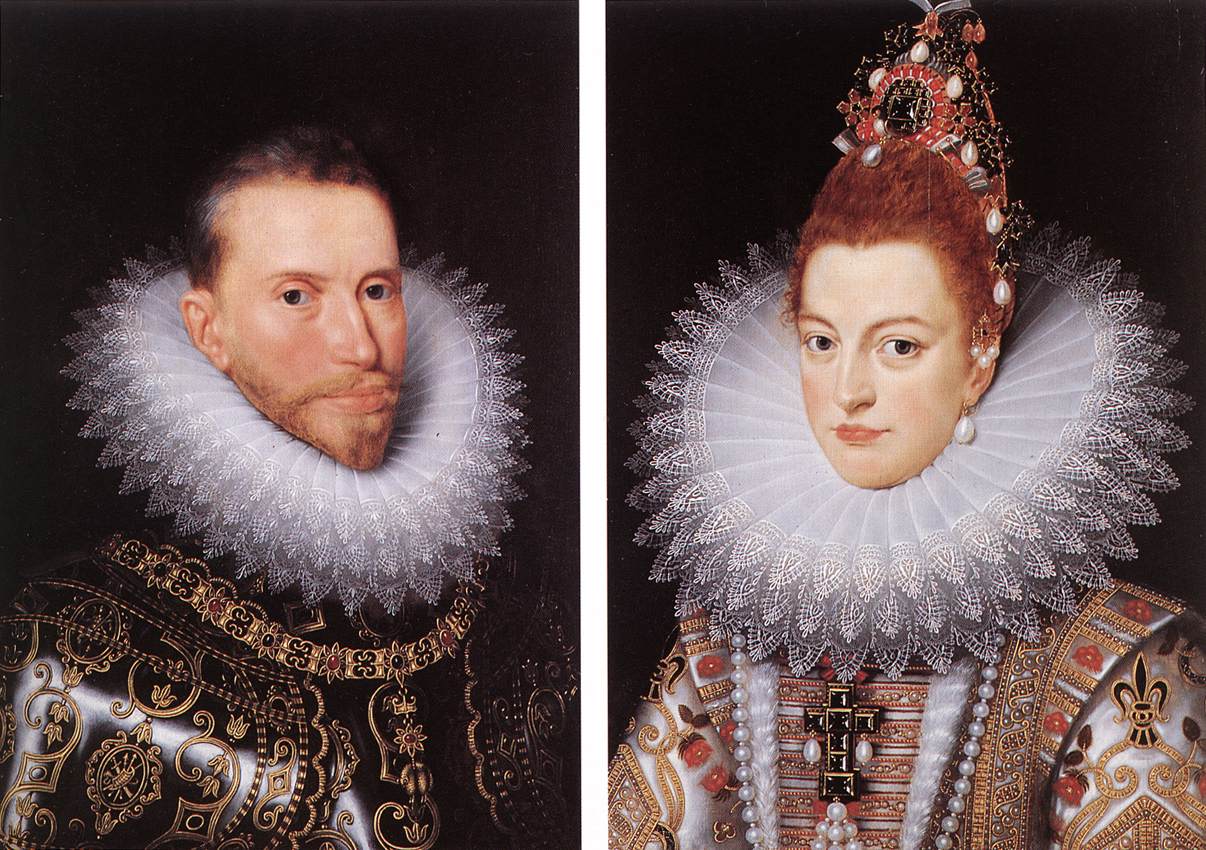
Ferdinand and Isabella

COLUMBUS  PLANS  HIS VOYAGE

Columbus now began to talk about his great dream. He could sail a ship straight west and reach the Orient with its riches of gold, gems, and spices. When friends asked how far he thought the voyage would be from Portugal to Japan he gave the dis­tance at about three thousand nautical miles. This would have placed Japan in the approximate location of the Virgin Islands.
Old sailors laughed, and muttered that he was out of his mind. Undiscouraged, Columbus appealed for help to King John II of Portugal. The king's advisors on navi­gation called his plan nonsense, and the king himself was shocked by the demands Columbus made. If his voyage should prove successful, Columbus wanted noble rank, the title of admiral, a share of the profits, and governorship of any lands he discov­ered!
Columbus carried his dream to Spain and at first he did no better in the court of King Ferdinand and Queen Isabella. Spain was at war with the Moors and could spare no money for Columbus. And the Spanish experts laughed as loudly at his wild idea as had the Portuguese.
But Queen Isabella did not laugh. If necessary, she would pawn the crown jewels to fit out an expedition for Columbus. To keep her from taking this step, the royal treasurer somehow raised the money. In round figures, it came to $14,000.


By:                 Earl Schenck Miers


Friday, September 2, 2005

Leif The Lucky Sails To North America Review

 
Grade 5.1.1.2
Review Questions

1. What is a "navigator"?
2. Who is believed to be the first white man to see North   
     America?
3. What is a "Norseman"?
4. Who discovered Greenland?
5. Which of Eric the Red's sons is the first to explore 
     North America?
6. Where are they believed to have landed?
7. What does "bleak" mean?
8. What is a "sound" as used in this passage?
9. What year did Leif and his crew spend the winter in 
     North America?
10.Who is Leif the Lucky's brother? 


Thursday, September 1, 2005

Leif The Lucky Sails To North America

Grade 5.1.1.1
Bold Norsemen set out from Greenland and explore the coast of an unknown land, but their discovery of North America is forgotten.


 A thousand years ago no voyager wanted to sail beyond the sight of land, for dark mystery haunted the open sea. No matter how carefully a navigator set his course, skies could blacken with an unexpected storm. Then rain fell, lightning flashed, thunder grumbled, and towering waves rose like walls around ship and crew. Equally dangerous, a cold night might be followed by a warm morning. At such times fog dropped like a curtain over the water and the winds grew still. In the silence, the sailors pulled on creaking oars. Cautiously their little ships edged ahead.
  In the year 986 A.D., Bjarni Heriulfsson, a brave Norseman, left Iceland to join his father in Greenland. Even though Bjarni [pronounced By-arni] never before had sailed these icy seas, old hands at the voyage told him not to worry. Cape Farewell, the southern point of Greenland, could be seen halfway across the sea from Iceland.
For three days, under fair winds, Bjarni and his crew skimmed over the waves to­ward Greenland. Then all at once the winds died away. That night, all next day, and the day that followed, fog settled over the water. No one knows for certain how many days Bjarni drifted, but long after he had ex­pected to reach Greenland, he was still on the open sea. At last the weather cleared and the following day Bjarni sighted land.
Bjarni now approached a shore that was level and wooded. Small hills rose in the distance. For some reason the Norsemen did not land, although they could not know then that instead of reaching Greenland, they probably were off the coast of New­foundland. Mystified, Bjarni sailed north­ward, first past a flat wooded country, then on to shores above which rose glistening ice mountains. The first white man known to have found the continent of North America simply looked and hurried away. In four days Bjarni arrived safely in Greenland.
Years went by, but Bjarni could not for­get the new country he had seen. Sometime after the year 1000, Bjarni told his tale to Leif the Lucky, son of famous old Eric the Red. Eager to see this strange land, Leif Ericson begged his father to go with him, for old Eric was the best navigator in the northern seas. Had he not, years ago, won fame as the discoverer of Greenland? Eric shook his head. He was too old now to at­tempt such an adventure. But Leif was young and strong. Go, Eric told his son. Seek your fame and fortune.
Leif bought a ship from Bjarni and en­gaged a crew of thirty-five men and women. One was a strange short fellow with a pro­truding forehead, a small face, and restless eyes. He was Tyrker, a German who had known Leif since childhood and was like a foster father to him. Next to Eric, Leif loved no man so much as Tyrker.


LEIF THE LUCKY EXPLORES THE NEW WORLD

Leif the Lucky left Greenland with strong winds filling the sails of his boat. Straight as an arrow he voyaged to the new country beyond the North Atlantic. His first sight of land was a bleak coast of many ice moun­tains (probably Labrador or northern New­foundland) and from the word hellur, meaning large flat stones, he gave the place the name of "Helluland." In a small boat a party went ashore, shivering in the breezes that swept down from the glaciers. There was not a single blade of grass on which to feed the cattle they had brought, and they decided to sail to the south.
The next land Leif saw may have been Cape Breton Island or Nova Scotia. Here the country was level and wooded, the beaches white and sandy, and Leif gave the country the name of "Markland," meaning Forest Land. Once more they set sail, seek­ing regions Bjarni had not described. Driven by a northeast wind, after two days they again sighted land.
Today no one can say for certain exactly where the Norsemen went ashore. But we do know that Leif and his followers landed upon an island somewhere along the Atlan­tic coast between northern Maine and southern Massachusetts. There was dew on the grass. When they touched moistened fingers to their mouths, the dew seemed sweeter than any they ever had tasted. They sailed across a sound to another strip of land, and Leif sent the swiftest runners in his party to explore the unknown country­side. These scouts, legend says, were a man and a woman, dressed in a kind of plaid and kilt such as Scottish Highlanders wear. They returned after two and a half days, with a cluster of wild grapes and a sheaf of wheat.
Leif decided to build dwellings and to spend the approaching winter in this land of the sweet dew. He sailed to an island where so many eiderducks nested the Norse­men found it impossible to step between the eggs. They discovered a river flowing into a lake where hundreds of salmon leaped in the water. Tall grasses supplied excellent food for the cattle, and close by were hillsides to shelter their huts. The year was 1003 A.D.
One day Tyrker the German—Leif's be­loved foster father—was missing. Twelve men were sent to search for him, but soon Tyrker returned, shouting that he had come upon hundreds of wild grapevines.
Leif embraced his old friend. He ordered the grapes gathered and dried so that they could be carried home. With the coming of the spring the ship was loaded and Leif set sail for Greenland. So ended the adven­ture of the first white men and women to dwell in North America.


THE  NORSEMEN ABANDON AMERICA

The following year Leif's brother, Thor-vald, visited the same land and found the winter dwellings that Leif had built. After this party left, other Norsemen visited these lands. Then mystery once more closed like a fog over the vast continent of North America. Almost five centuries passed, and not another white man appeared on the sandy beaches where Leif the Lucky had made his home.


By:                 Earl Schenck Miers
Paintings:      Alton Tobey